
Root-to-Fruit
Strategy
Root-to-Fruit is a way to see the invisible roots of social change.

What is the root-to-fruit Strategy?
Root-to-Fruit is a systems approach to narrative strategy created by Big Bite Communications. It maps how underlying cultural patterns and shared beliefs shape visible stories, messaging, and organizational communications.

The Problem
Most campaigns start at the surface, focused on quick visibility or a clever message. They might grab attention for a moment, but without a connection to what people already believe or care about, they fade fast. They’re not culturally rooted. Lasting narrative change depends on building shared meaning, less on how we talk about change, more on how people come to believe in it. Funders often miss this, investing in moments instead of meaning or world building.
The Metaphor
Root-to-Fruit borrows from the logic of a living natural system. Culture is the soil — the myths, norms, and shared history that shape what people see as possible. Values are the roots, deep and mostly unseen, anchoring how we interpret the world. The trunk is the narrative — the through-line that connects those roots to public life and imagination. Branches and leaves represent the stories and messages that grow from it, while the fruit is the real-world impact: the actions, attitudes, and structures that reflect and seed those ideas.

The Approach
We created Root-to-Fruit to map how meaning moves through your field. We look for what’s nourishing your work and what might be depleting it. From there, we identify where your values overlap with those of your public — whoever that is for you — and design communication approaches that grow from that common ground. We make sure that each story or message you put out connects to culturally rooted narratives that can nourish your work and spread seeds of change. It’s a way to work with the ecosystem around you, rather than against it.
The Outcome
Working from the root up helps our partners see the forest with the trees — how ideas move, take hold, and replicate over time. It connects communications, culture, and systems change, turning narrative from a one-off tactic into a design strategy that focuses energy and resources where meaning already exists, so change has the best chance to take hold.
In Practice
Timeline adventures-
Global Dialogue’s 5x5x5 initiative wanted to explore new ways to make narrative change tangible — to help funders and advocates feel how narratives and their stories shape collective possibility. They needed a creative proof of concept that could show how imagination itself functions as infrastructure for change.
-
Alongside longtime collaborator Karen Heredia, we designed Timeline Adventures as a day-long, place-based environmental storytelling experiment across lower Manhattan and Governors Island. Participants physically walked through time — from a pre-colonial past to an alternate present and into a hopeful future — using geocached site discoveries, soundscapes by local musician Therese Workman, freshly prepared local indigenous food, AR landscapes, and hands-on stewardship activities with local organizations to experience how values and imagination shape what we see as possible. The adventure turned New York City into a living classroom for how narratives take root, grow, and seed new possibilities.
-
Participants — all everyday people from NYC and NJ — described Timeline Adventures as one of the most memorable and inspiring days they’d had in the City. The experience helped them see the present with new eyes, reconnect with place, and see their surroundings through a lens of care and possibility. It sparked new connections among participants and local partners, strengthening community ties while showing how immersive, multi-sensory storytelling can surface overlooked narratives and make alternate futures feel tangible. Ultimately, it demonstrated how green economies could create a physically more pleasant urban environment.
“It was one of the best days—it helped me slow down, connect with new people, and see my city with fresh eyes.”
Why This Matters
Without Root-to-Fruit
Narrative work is forced into marketing timelines and KPIs that don’t fit the target outcomes
Messages built in isolation from the culture they’re meant to shift
Funding that dries up before the roots have a chance to grow
Success gets judged by noise, not by what actually takes hold
With Root-to-Fruit
Narrative gets treated as a cultural strategy — the foundation beneath every story you tell
Messages grow from shared meaning, built to seed and endure
Investments get made with patience, and are designed to build depth not just visibility
Success gets measured in belief, alignment, and the stories people carry forward
Bring
Root-to-fruit into your work
Discover how we translate this framework into clear, grounded strategies for change.

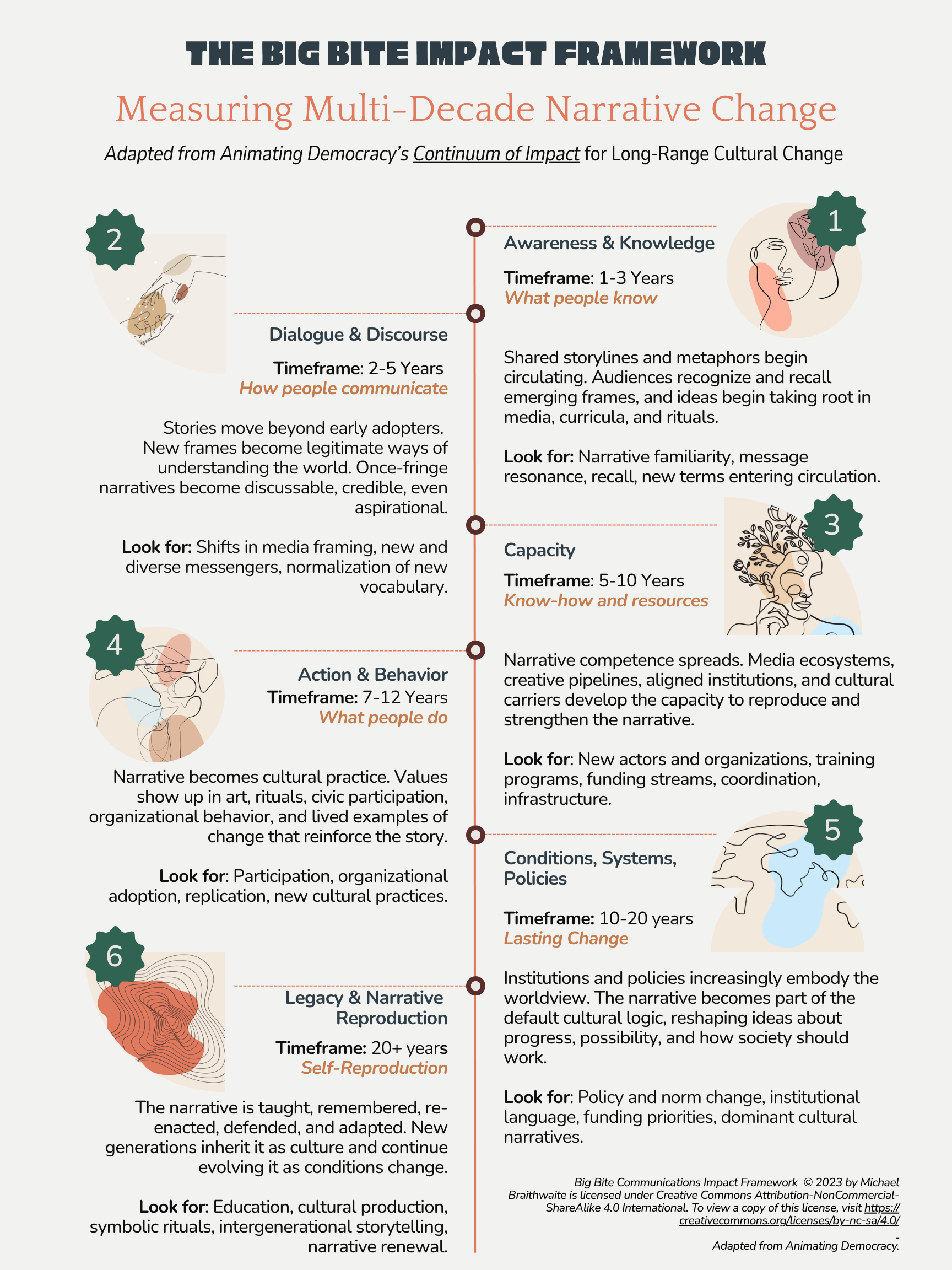
The Big Bite Impact Framework
Measuring Multi-Decade Narrative Change
Most funders and civil society organizations operate at the level of short-term narrative seeding, deploying individual campaigns, messaging frames, and storytelling projects. True narrative change operates on the level of cultural evolution; it requires sustained investment over multi-decade horizons.
Adapted from Animating Democracy’s Continuum of Impact, the Big Bite Impact Framework bridges short-term campaign metrics with long-range cultural transformation. It serves a dual purpose.
For Funders: Provides realistic timelines, milestones, and leverage points for multi-decade narrative investments.
For Organizations: Offers clear indicators to demonstrate how short- and mid-term communications build cumulative momentum toward durable systemic change.
-
BIG BITE Impact Framework: Summary & Stage Breakdown
Adapted from Animating Democracy’s Continuum of Impact, the BIG BITE Impact Framework bridges short-term campaign metrics with long-range cultural transformation. It outlines six core stages of narrative progression across multi-decade horizons:
Stage 1: Awareness & Knowledge (1–3 Years)
Focus: What people know.
Progression: Shared storylines and metaphors circulate; emerging frames take root in media, curricula, and rituals.
Indicators: Narrative familiarity, message resonance, recall, and new terms entering circulation.
Stage 2: Dialogue & Discourse (2–5 Years)
Focus: How people communicate.
Progression: Stories move beyond early adopters; new frames become legitimate ways of understanding the world. Once-fringe narratives become discussable, credible, and aspirational.
Indicators: Shifts in media framing, new and diverse messengers, and normalization of new vocabulary.
Stage 3: Capacity (5–10 Years)
Focus: Know-how and resources.
Progression: Narrative competence spreads; media ecosystems, creative pipelines, aligned institutions, and cultural carriers develop capacity to reproduce and strengthen the narrative.
Indicators: New actors and organizations, training programs, funding streams, coordination, and infrastructure.
Stage 4: Action & Behavior (7–12 Years)
Focus: What people do.
Progression: Narrative becomes cultural practice; values show up in art, rituals, civic participation, organizational behavior, and lived examples.
Indicators: Participation, organizational adoption, replication, and new cultural practices.
Stage 5: Conditions, Systems, Policies (10–20 Years)
Focus: Lasting change.
Progression: Institutions and policies embody the worldview; the narrative becomes part of default cultural logic, reshaping ideas about progress and possibility.
Indicators: Policy and norm change, institutional language, funding priorities, and dominant cultural narratives.
Stage 6: Legacy & Narrative Reproduction (20+ Years)
Focus: Self-reproduction.
Progression: The narrative is taught, remembered, re-enacted, defended, and adapted; new generations inherit it as culture and evolve it over time.
Indicators: Education, cultural production, symbolic rituals, intergenerational storytelling, and narrative renewal.